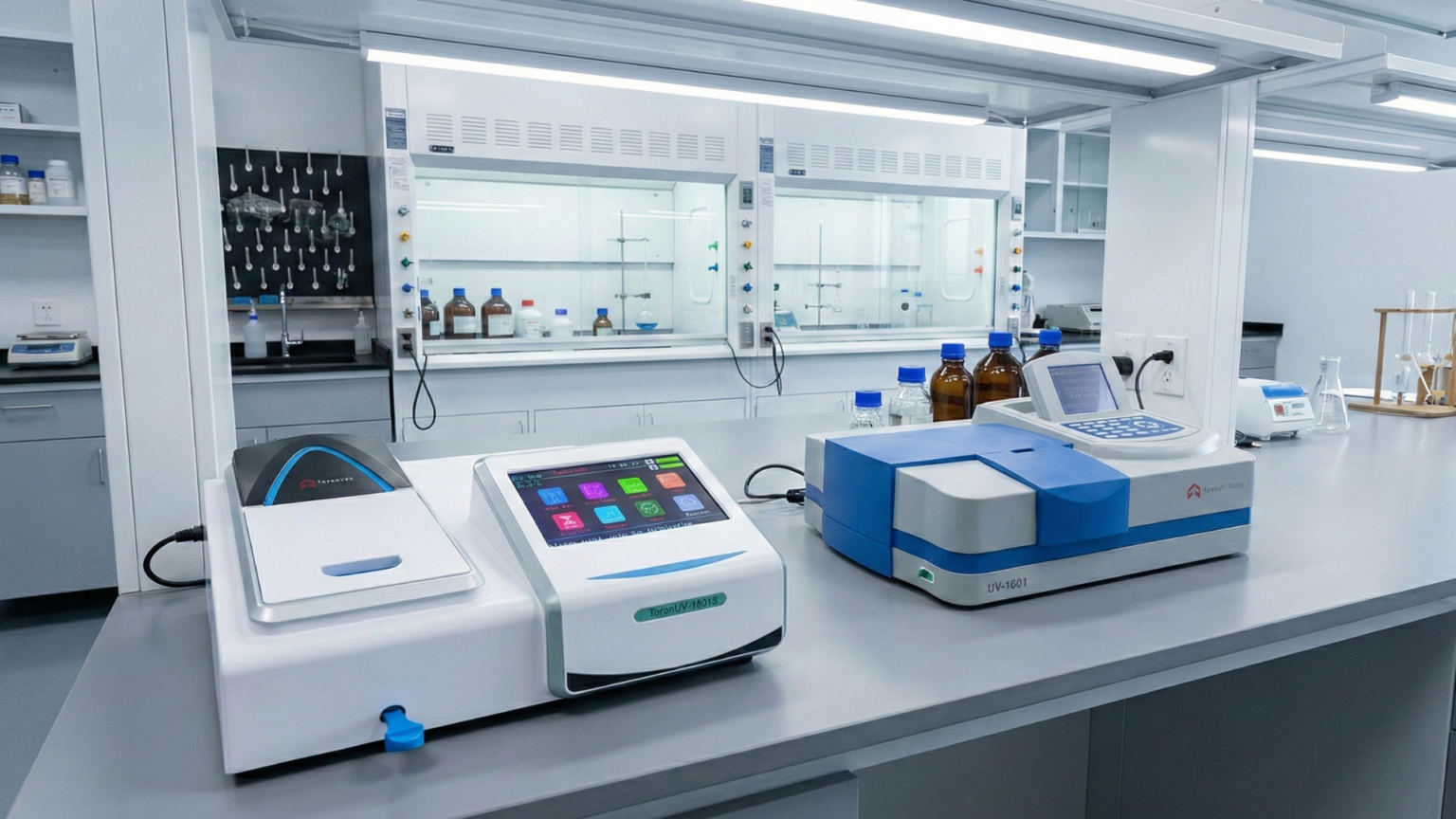
Selecting the right UV-VIS Spectrophotometers is a pivotal decision for any modern laboratory, directly impacting the precision of your analytical results. A UV Vis spectrophotometer is a sophisticated instrument used to measure the absorbance and transmittance of a sample across the ultraviolet and visible spectrum (typically ranging from 190 nm to 1100 nm). By applying the Beer–Lambert law, these instruments quantify the concentration of analytes in sample types ranging from liquids to gases.
- Define Your Applications and Test Workflows Before Selecting UV-VIS Spectrophotometers
- Wavelength Range, Bandwidth, and Optical Performance Requirements
- Single Beam vs Split Beam vs Double Beam UV-VIS Spectrophotometer Design
- Accuracy, Baseline Stability, Stray Light, and Repeatability Considerations
- Software, Data Handling, and Compliance Needs for QA/QC and Procurement
- Why Torontech Is the Best Choice for UV-VIS Spectrophotometers
This UV-VIS spectrophotometer selection guide outlines the technical benchmarks and optical configurations you must evaluate to ensure your lab remains efficient and compliant.
Define Your Applications and Test Workflows Before Selecting UV-VIS Spectrophotometers
The complexity of the uv vis machine you need depends heavily on your specific industry and the sensitivity required for your assays. UV-VIS spectrophotometry is a versatile technique, but the “perfect” instrument varies by application:
- Pharmaceuticals: Often requires high photometric accuracy for API analysis and strict adherence to regulatory validation.
- Environmental Testing: Focuses on detecting trace nitrates and phosphates in water samples.
- Biotechnology: Requires specialized micro-volume capabilities for DNA, RNA, and protein quantification.
- Food & Beverage: Used primarily for monitoring color, additives, and purity levels.
Wavelength Range, Bandwidth, and Optical Performance Requirements
The core of an instrument’s performance lies in its ability to resolve closely spaced absorption peaks.
- Wavelength Range: Ensure the instrument covers the full 190 nm to 1100 nm range if you plan to analyze both organic compounds (UV) and colored complexes (Visible).
- Light Sources: Look for a combination of a deuterium lamp for the UV range and a tungsten-halogen lamp for visible light to ensure consistent intensity.
- Spectral Bandwidth (SBW): A narrower bandwidth (e.g., 1 nm or less) provides higher resolution. If your method development involves complex samples with overlapping peaks, a high-resolution monochromator with a fine diffraction grating is essential.
Single Beam vs Split Beam vs Double Beam UV-VIS Spectrophotometer Design
The optical path design determines the stability of your measurements over time.
- Single Beam UV Vis Spectrophotometer: The simplest design where light passes through one sample at a time. While cost-effective, it requires frequent recalibration of the “blank” to account for source fluctuations.
- Split Beam UV Vis Spectrophotometer: Uses a beam splitter to monitor the light source intensity, providing better stability than single-beam models without the full cost of a double-beam system.
- Double Beam UV Vis Spectrophotometer: The gold standard for QA/QC. It simultaneously measures the sample and the reference (blank), automatically compensating for baseline drift and lamp fluctuations. This is ideal for long-term kinetic studies or high-throughput workflows.
Accuracy, Baseline Stability, Stray Light, and Repeatability Considerations
When evaluating technical data sheets, pay close attention to these performance metrics:
- Stray Light: This is unwanted light outside the chosen wavelength that reaches the detector. High stray light levels cause significant errors in high-absorbance samples.
- Wavelength Accuracy: Ensures the UV/VIS spectrophotometer is actually measuring at the exact nanometer specified.
- Signal-to-Noise Ratio (SNR): A higher SNR allows for the detection of very low concentrations, which is critical for trace moisture or impurity analysis.
- Baseline Stability: Look for low baseline drift to ensure that your measurements remain consistent throughout a long day of testing.
Software, Data Handling, and Compliance Needs for QA/QC and Procurement
A high-performance UV/VIS spectrophotometer is only as good as the software that drives it. For modern QA/QC teams, software must go beyond simple data collection:
- Compliance: Does the software support 21 CFR Part 11 (audit trails, electronic signatures)?
- Validation: Built-in routines for instrument calibration and validation save hours of manual labor.
- Accessories: Consider the availability of specialized cuvettes (quartz or glass) and various path length (10 mm) options to accommodate different sample volumes.
- Integration: Can the data be exported easily to a LIMS or other laboratory management systems?
Why Torontech Is the Best Choice for UV-VIS Spectrophotometers
Choosing a Torontech UV-VIS Spectrophotometers means investing in long-term reliability and analytical excellence. We provide a range of solutions from robust single beam UV Vis spectrophotometer units for routine checks to advanced double beam UV Vis spectrophotometer systems for complex research.


Our instruments are engineered with superior monochromator technology and high-stability lamps to ensure your UV-VIS spectrophotometry results are accurate, repeatable, and audit-ready. Partner with Torontech to elevate your lab’s precision and streamline your quality control processes.